Monday, March 20, 2023

Bush Orientation Part 2: Culture Conversations

 On Day 3 of our time in Sangapi, we start off the morning with a hike up to another ridge nearby. This time, we are accompanied by the village health workers, who are hosting us. They offer a lot of insight into cultural practices, which makes our time with them very educational! Like all of the trails up and down the mountainsides, the shortest route is taken: straight up the slope. Having received some rain the previous night, the red clay quickly turns to mud and is exceptionally slick. Keeping one foot in the grass on the side of the trail is my approach to gaining some traction; since our hiking s
hoes were still drying after washing them following yesterday's trek, our Crocs and flip-flops are not the most ideal footwear! 

After an approximately 45-minute hike, we arrive at the top of the ridge and walk a little further down the trail to meet some of the people who live on this ridge top. The owner of a piece of land shows us his two houses, as well as the new house that is currently being constructed. One of the houses is built on stilts, which prompts a discussion about why houses are built differently. We learn that it comes down to preference: often, younger people enjoy houses on stilts, whereas the older generation usually prefer to sleep on the ground level where the floor retains heat better during cool nights. After taking some time to look around and ask questions, we make the trek back to Sangapi where Nova is able to play for awhile before nap time. With another volleyball game and dinner also complete soon after, we are ready to relax for the evening. 

We heard the news that Saturdays are a community meeting day in Sangapi, so we are excited to see what the day will bring when we wake up! Everything is still very quiet when we head outside around 9am, so we start with a walk up the airstrip. There are many gardens on all of the slopes leading down the ridge; this morning, however, we see people actively at work in a garden that is close by. Asking a few kids who are tagging along with us if they know how to get to that garden, they lead the way and we ask for a tour when we arrive. The owners of the land are thrilled to show us around their "yard," explaining how life is for them. One gentleman wants us to ask as many questions as possible, and he shares his worldview with us very openly. His pride of Sangapi, his tribe, and the peace that they exhibit shines through in all of his answers. Following a conversation with him, his elderly father arrives from working in his new garden. Like son, the father is eager to show us the work he was doing and demonstrates how he uses a shovel to manually turn all of the soil before planting. Mid-work, he turns his toque so that it is straight (yes, we're still trying to understand how so many people wear toques in the scorching heat!), poses, and explains that this would be a very good picture. 

After a tour of the garden, the son shows us his wives' houses as well as his own. Traditionally, husbands are never allowed to enter their wife's house, and vice versa. Since this seemed to be a very traditional family, we asked some direct questions -- and got some answers that were more direct than others. "You have two wives? How many do you want?" "You are never allowed in each others' house? How is it possible for you to have children?" "Do your wives ever fight with each other?" Though they thought it was pretty funny for us to be asking these questions out loud, they were surprisingly open with us. We learned that this particular man wanted 5 wives (which would take awhile, considering the bride prices in the area), that the garden is used for having children, and that he is very fair and takes turns with his wives so they don't fight. While amusing to us, this is just life for many people in PNG; the way it has been is often the way it will be. 

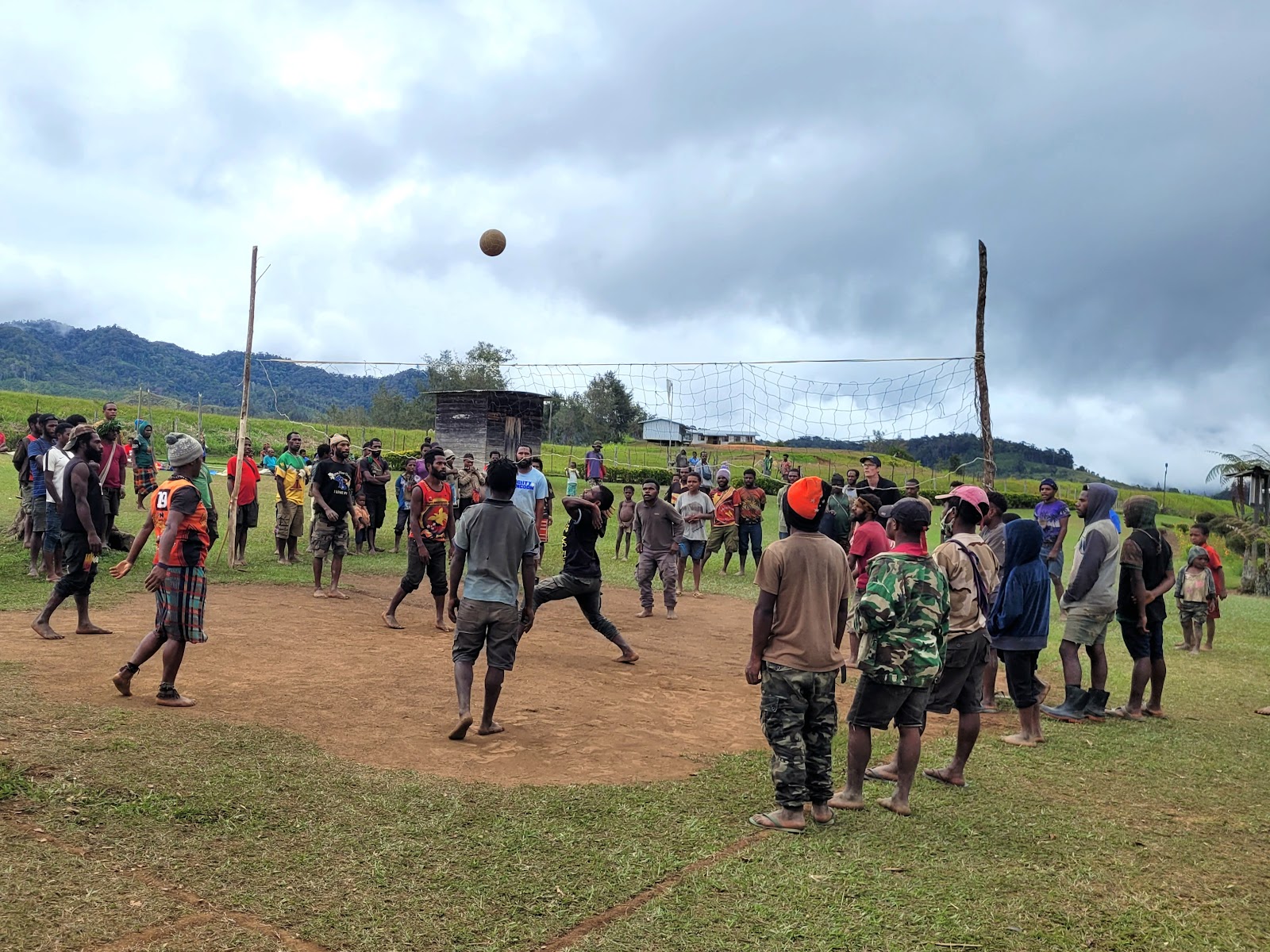
We thank the family for their tour and then head back to the village to see if the community event has started. People come to this event each weekend, some hiking 2-3 hours to arrive. This means that people trickle in slowly, but by noon the air is lively with chatter, a small market, and volleyball and basketball tournaments. Brandon joins the Sangapi team in a volleyball tournament: when it is his turn to play, the crowds flock around to watch the "tall white man." If he doesn't hit the ball for a minute or two, they all start calling out, "White man! White man!" If he hits the ball (or even better, spikes it), the crowd goes into an uproar of cheering and laughter. By uproar, I mean that Nellicia could hear exactly when Brandon hit the ball from our house, which was a 5-10 minute walk away! We had a great afternoon talking to people from various communities, and really enjoyed the event -- it was so simple, but allowed so many people to connect with each other in friendly conversations and sport. 

With yet another busy day complete, we relaxed for the evening and prepared for Sunday. In church on Sunday, while most people sit on low benches that are about 6 inches off of the dirt floor, we were treated as guests of honour with plastic chairs. After speaking only Tok Pisin since our arrival, we were able to follow the sermon quite easily, which was a sign of our progress! We were all thankful for a day of rest after the busy days we had just had, and at the end of the day were excited for the new week ahead. 

Friday, February 24, 2023

Bush Orientation Part 1: Exploration

Watching as the MAF airplane disappears from sight, we get the first impression of what it means to be isolated. Here we are: three white people standing among a crowd of locals, in a village where we know nobody, with nothing but two suitcases and a cooler containing the food and clothes we'll need for the next week. With the excitement bubbling around us, there is nothing that we can do but feel excited about what the next week in Sangapi will hold! 

Several men from the village offer to carry our bags for us, and we take in the sights as we follow them to our temporary home. Sangapi lies on a small mountain ridge at an elevation of nearly 2,000m above sea level, but is surrounded on all sides by taller mountain ranges. We see bush houses and gardens dotting the mountain sides around us; the only buildings with a tin roof are the small health clinic, school buildings, and mission house, which are all situated on the perimeter of the airstrip. Since no roads lead to Sangapi, there are no vehicles to be seen. Instead, the sound that greets us is the whir of a lawnmower busily working to keep the grounds around the health centre and mission house looking tidy.

We settle into our house and unpack our things before going on a short walk to explore the area around the airstrip. Later in the afternoon, Brandon starts a daily tradition of playing volleyball with whoever would like to join. Shy at first, most stand at a distance to watch while Brandon plays with only the bravest kids. Not long after, others gather their courage to play with the "white man" too, and soon the game is filled with people and laughter. We receive a welcome gift of potatoes and onions from a village lady, and head home for dinner as the rain starts and the sun goes down.

We wake with the roosters at 4am the next morning, who must think they are the sunrise's alarm! After trying to rest for a few more hours, we have breakfast and head outside to explore. As we were starting our explorations yesterday, we saw a path that led out of the village that we planned to explore today. Starting down the path alone, we are soon joined by several children (and not long after, a few adults as well). We realize that this path leads all the way down the mountainside to a river below, and that the people walking with us expect to accompany us all the way to the river! With no idea how far it is, we decide to go with them at least a short way. 

Soon, the relatively stable dirt path turns to oozing mud. This is no big deal for everyone else, since they march through the mud in their bare feet -- which were already dirty to start with. For us, getting our runners covered in mud with 6 days of our trip left has us thinking twice. We decide that a little mud shouldn't stop us, and continue. Not long after, we come to a stream with a log lying across as a makeshift bridge. Again, we stop to think twice! Not only does the log look slippery, it is at least a few feet fall to the stream below.. and Brandon is carrying Nova, which means he is lacking the use of his arms. This time, we decide to cross the muddy stream instead of using the bridge, but again continue on with our "tour guides." Their balance and dexterity impress us; a young boy of about 7 has been carrying a toddler on his shoulders nearly the entire way, never slowing or hesitating for a moment. A woman is carrying her newborn in a string-bag, supported by her forehead. Even though the baby is only a few weeks old, this hike does not phase the mother. 

Once we reach the river with the "big bridge," we stop to rest while the ladies carry on. They are headed to their garden to harvest some food, which they will then carry back up to the village. The children have a quick swim in the river while we rest, and then head back up with us. About half way back, a few of the children veer off down another smaller path. We ask the others where they are going, and one boy says that their house is that way. Asking if it is okay for us to see where they live, we follow this smaller path. The girl who lives at the first house shows us around her family's property; they are currently in the process of building a new house, but live, cook, and sleep in their old house for the time being. After seeing this house, the children invite us up another path to see even more houses. Some of them live in houses on stilts, others in rectangular houses, and some are round. Some families cook and sleep in the same house, while some have a separate "cook house." All of them are similar in that they are made completely out of bush materials, usually woven together and tied with bush rope. After seeing where four or five of the children live, we make it back to our own house -- tired, yes, but glad that we braved the mud!


After another afternoon game of volleyball (and a game of chase-the-chickens for Nova), we head back to our house for the night. This evening, we prepare more thoroughly for the rats which we discovered the previous night! Though the fridge in the house doesn't work, it serves as a great storage place for any food that is not in Tupperware containers. Any food that we think they might possibly enjoy -- or test -- is put away in the fridge or cooler. Despite all of our cleaning and "removing" efforts, they still feel the need to check for treats each night, which leaves us the job of cleaning up after them each morning. Mental note: next trip to a bush village, bring a rat trap!

Monday, January 16, 2023

Commitments

Visits to the local orphanage are becoming increasingly common as I (Nellicia) realize the needs of the place. It is incredible to see how hard the children work every day in the scorching heat – plowing fields by hand, planting vegetables, harvesting crops, cooking their own meals, hand-washing clothes, etc. It is heartbreaking to realize that these children do not know how to play without an adult guiding them. The shy, friendly smiles that greet me with each visit make me want to learn more than just their names. Their personal stories are still largely unknown to me: who they are, and why they are here. At the same time, I am afraid to learn more. I know that only about half of the children living at BFO are truly orphans. The other half leave stories of violence and abuse behind that made it too dangerous for them to remain at “home,” but this somehow makes their stories even more tragic.

As I considered where and in what capacity I would like to be involved in ministry during our time in Mount Hagen, the needs of the orphanage kept coming back to me. Yes, there are major teacher shortages both in local and international schools. There are expat children who could benefit from music lessons or tutoring. There are part-time roles open within MAF that I could have stepped into. But none of these opportunities had a grasp on me as strongly as the needs of the children at BFO. And so, with the decision being made, I have started to become more involved. 

My first concrete step of involvement has been teaching a course to the children on Personal Safety and Abuse Prevention. With a large proportion of the children having experienced some form of abuse or assault, along with the fact that the culture in this area is one where violence is expected and domestic violence is accepted, this was a clear area of need. Starting with discussions about different feelings and what situations may create those feelings, we soon moved on to discussing feeling safe versus unsafe and how our body gives us clear signs when we are feeling unsafe. We discussed more sensitive topics such as what parts of our bodies are off-limits and how we should respond if someone breaks those limits. The final part of the course will be a session where each child creates their own safety network, with five trusted adults that they can talk to about sensitive topics. Of course, it will be difficult for these children to come up with five adults that they know, and even more difficult to think of five adults to whom they would disclose personal, and in this culture, shameful, information. However, I believe this course is only a start that I am hoping can be built on through the development of healthy and trust-filled relationships. 

While teaching this course, I was also able to spend some time observing the children’s typical school day. Since most children come to the orphanage with very little English and no formal education, it makes it difficult to have standard schooling. For this reason, each child starts with a self-paced Christian homeschool curriculum to get “caught up,” or at least learn the basics of reading and writing. When the child reaches a Grade 5 level, they begin going to public school. A few things that I noticed while observing were that this curriculum, though it has a Christian lens, only teaches the core subject areas of Reading, Writing, Math, Science, and Social Studies. Students also work through their various workbooks as their sole method of learning; there are no activities, presentations, or projects. They receive a goal for each day, and work quietly until they complete the goal, at which point their schooling is complete – whether that be at 11am or 2pm, they must sit quietly in school until 3pm. 

Seeing this setup (which is a lot to ask of the orphanage considering the help and supplies that are available), I realized that I could help enhance the education experience in a few small ways. And so, beginning in the new school year (which starts at the beginning of February), I will be returning to my role as a teacher to support the helpers that are leading the schooling and to try to implement a few changes. 

Briefly, some of the initiatives that I am most excited about: I plan to teach regular Bible classes. I feel that this is an important part of my ministry to the children, and hope that they will gain a passion for God and His Word through these classes. I will also be adding some “extra-curriculars” into the school day, such as P.E., Art, and read aloud time; the goal of these is that they will ultimately be planned and lead by some of the older students. A few other small changes are not worth mentioning here, but I am excited to see how the children respond to these extra activities and classes! And as with all aspects of our family’s ministry in PNG, we pray that God will work through us to bring about lasting change in the hearts and lives of people throughout this country; change that is so desperately needed.

Friday, December 23, 2022

Airborne

     In the air at last! With my training now underway, it has been great to be in the air and see not only the country, but also the work that is being done using MAF airplanes. The first two weeks of my training was as an observer pilot, to allow me to get the feel for a "day in the life." In this time, I experienced many different areas of the country, types of airstrips, and community greetings. One of my highlights of these two weeks was a flight to a remote village to pick up Dr. Mills, along with his team of doctors and nurses, after they completed a health patrol. This experience was very special, since it was Dr. Mills' last health patrol after 20+ years of service in Papua New Guinea. In his time in PNG, he built and operated one of the most well-known mission hospitals in the country (the hospital in Kompiam, which is where we did part of our language training). On our arrival in Kompiam to drop the team off, there was a blur of emotions and celebrations. Flower petals were thrown at Dr. Mills, and he was presented with precious watermelons and other fruit as a gesture of appreciation for the work he had done. My souvenir of the day was a 12 kilogram watermelon, since Dr. Mills decided he couldn't eat 20 or more watermelons in the time he had left in PNG!


    After two weeks of observing, it was time for me to switch over to the pilot's seat and use the controls for the first time. I had a few days of instruction to prepare for a flight test that would allow me to convert my Canadian pilot's license to a PNG license. This training was a refresher of my training in Uganda, and went well; thankfully, the test also went smoothly which means I can now fly with cargo and passengers.

    One day of my training is especially memorable, as it showed me the difference that MAF can make in life and death situations. After spending the morning in the air practicing for my upcoming test, we received a call that there was an urgent medevac in the west of the country. No other pilots were available, so we had to make a decision whether to continue my training for the day or to take the medevac (with my training pilot flying and me as an observer). We learned that a mother had recently given birth to twins and was now losing approximately one litre of blood per hour; she desperately needed a hospital if she and her newborn twins were to survive. My training pilot and myself decided that my test wasn't more important than someone's life, so flew the medevac. We picked the mother and two newborn babies up from a village, as well as another patient who needed medical care, and flew them to the nearest hospital that could provide adequate care. When we arrived in this next town, an ambulance was waiting to transport the mother to the hospital. It really is an incredible feeling to be a part of something so life transforming!

    On the "home" side of things, Christmas is fast approaching. In an attempt to make our first Christmas in PNG special (but still have a few reminders of Christmas in Canada), we are planning a dinner on Christmas Eve. With turkeys unavailable, and chickens of questionable quality in the stores, we had to get creative! Yesterday we dropped off a local "haus meri" (house lady, or househelp) at the big market in town to buy a live chicken. While we carried on to do some shopping, she took public transport to bring the chicken back to our compound. Though we are sad to have missed the process, we arrived back home with a freshly killed and cleaned chicken waiting on our counter! We are excited to share our first Christmas dinner in PNG with our neighbours, and plan to finish the evening off with some Christmas carols and gezelligheid. 

    While these small pieces of tradition do help it to feel more like Christmas, we also know that the most important part of Christmas has nothing to do with turkey or snow. This reminder helps us to realize that despite the things that are "missing" this year, Christmas still has the same meaning. Though it will be with different people, we are looking forward to celebrating the birth of Jesus -- and pray that His birth, life, and ultimate sacrifice will be made real and relevant in the lives of many throughout PNG and back in Canada. We wish everyone a blessed Christmas and happy holiday season this year! 


Friday, November 11, 2022

Normalcy

 "Welcome to normal life!" This is our current feeling, since we have now completed our orientation to the PNG program and our schedule of events has ended. However, we have no idea what normal life does or will feel like, since we haven't experienced it for such a long time. Time will tell what routines and structures we settle into here, but we are excited for normalcy to return. 

Something that has been a bit more difficult for us to get used to have been quiet nights. For the months before our move, we were visiting family or friends approximately 4 to 5 nights per week. Now, we are home every night (and we can only talk to family during the day, since they are sleeping when it is evening here)! We have been trying to designate certain evenings to have certain events; boardgames on Friday, visiting on Saturday, a Bible study on Tuesday, etc. This has definitely helped to add some structure to our days and weeks. 

Brandon has been itching to fly, a feeling that was escalated by the constant buzz of planes landing and taking off (we live right next to the airport). Now that our orientation is complete, he will begin his in-country flight training! Since Papua New Guinea has complex topography and weather, the training process is very thorough -- something I am grateful for. This means that he will spend the first months flying with a pilot who has plenty of experience flying in PNG before taking off on his own.

As for myself, I am still exploring the boundaries of what I can commit to with a little one in the house. Various opportunities have come up that I am taking time to think and pray about before agreeing to anything. That being said, I realize that boredom will be my first enemy if I remain in the house without any other commitments, so I am excited to see what comes my way in the coming months! 

All in all, life is starting to settle into the ordinary. Chaos isn't the number one descriptor of how things feel anymore, which I believe is a good validation of how far we have come. As with all things, we only have God to thank for the incredible way everything has turned out to this point. "But if not" (Daniel 3:18): if things get tough or difficult, if it doesn't feel like we are making an impact, if we can't feel God's presence, if things don't seem to be going according to plan -- but if not, He is still our only hope and help. 


Saturday, October 22, 2022

Kompiam

   Our time in Kompiam, a remote village in the mountains of Papua New Guinea, is nearly complete. The purpose of our two-week trip was primarily language training -- but we have gained so much more than just language skills in this short time. From stepping out of the plane and being greeted by a crowd of onlookers to witnessing a woman getting chased away like a wild animal to stepping into our house and realizing that our cooler with our vegetables, meat, milk, cheese, and butter was missing, Kompiam has been an adventure and incredible learning experience from the outset. 
   One of the biggest takeaways from this time has been the opportunity to immerse in the richness (and complexities) of the culture. Our next-door neighbours live in a bamboo hut, and the smell of smoke wafting into our house means they are cooking their next meal. In our daily lessons, we learned many things: that pigs and money are the two main signs of wealth, and that pigs can be bought and sold for over a thousand dollars; that bride prices must still be paid in this area, which typically consist of a sum of money as well as a certain number of pigs; that the mothers' clan must be compensated if a child dies; and that there are still many superstitions and varied beliefs about healthcare, which results in complicated medical situations. We have learned so much in such a short time, and appreciate the openness of our teachers to discuss sensitive things about cultural values and practices. 
   We have also taken time to enjoy the beauty that is all around us. One of the first days that we were here, we hiked down a road to a nearby river. Today, Brandon went on a hike down the side of a cliff with a few men he met and was able to see their garden. As he went down, he saw a woman harvesting sweet potato. As he hiked back up, the same woman was carrying a large sack of sweet potato up the cliff like it weighed a feather. The strength and dexterity of the people here really puts our physical fitness to shame! We also explored the scenery of the area with our drone, explaining to curious passersby (who inevitably crowded around rather than passing by) that it is "a little airplane that can take pictures." The rolling hills and mountains, gurgling rivers that are peaceful on dry days and foamy after rain, and little dirt paths that lead to a house or garden in some isolated place never fail to awe us. Regardless of all the complexities, problems, and difficulties that come with the isolation and remoteness of Papua New Guinea, it really is a beautiful country. 


Wednesday, September 28, 2022

BFO visits

   My (Nellicia's) visits to a local orphanage, Bible Faith Outreach, or BFO, have been one of the highlights of my time in Mount Hagen so far. Started by a national who had a heart for children with no place to go and nobody to care for them, the orphanage has expanded from a garage to a residence with a girls and boys’ dorm, a kitchen, dining room, large garden, and a small house for the lady who founded the orphanage – known to the children as “Mommy.”
   On the first visit, the younger children were thrilled to see a new face and eagerly gave me a tour of their home. I learned the names of the eight to ten children that were giving the tour, and it was great to see their faces light up as I said each of their names; I undoubtedly pronounced them incorrectly at first, but we’ll get there! On the tour, I learned several things about the orphanage: 
   When the orphanage moved from a garage to the new property, there was no power available. The children used a traditional cooking hut to cook their food, but many of them were getting lung problems because of their exposure to smoke. Seeing this, an MAF volunteer designed a new kitchen with a tap, sink, and stove. After raising enough money to complete the project, the new kitchen was built with solar power to fuel it. It was great to see the girls using the kitchen as they baked fresh bread for lunch!
   The boy dormitory was completed first, which meant that the boys moved to the new property while the girls still lived in the garage. It was constructed in the traditional way of weaving bush materials together, creating a single room structure. Following this, another MAF volunteer was made aware of the need for a girls’ dorm, and as an engineer he designed a multi-room dorm constructed out of storage containers. In this dorm, there are approximately eight bedrooms which sleep two or three girls each. There is also a bathroom with shower stalls, but unfortunately the bathrooms and showers do not have running water yet, which means the children still use buckets to shower. 
   Through funding, it is the orphanage’s aim to send each child to school. However, because they come at any age and with little to no education experience, a teacher helps the younger students catch up. Following an Australian Christian homeschool curriculum, this teacher helps the students until they reach a Grade 4 or 5 level, at which point they go to school to continue their education. 
   After my tour of the orphanage, I played a few games with the children before leaving. As there was no ball, string, or any other supplies, we stuck to the classics: tag and a few other high energy games. In the scorching sun, I didn’t last very long!
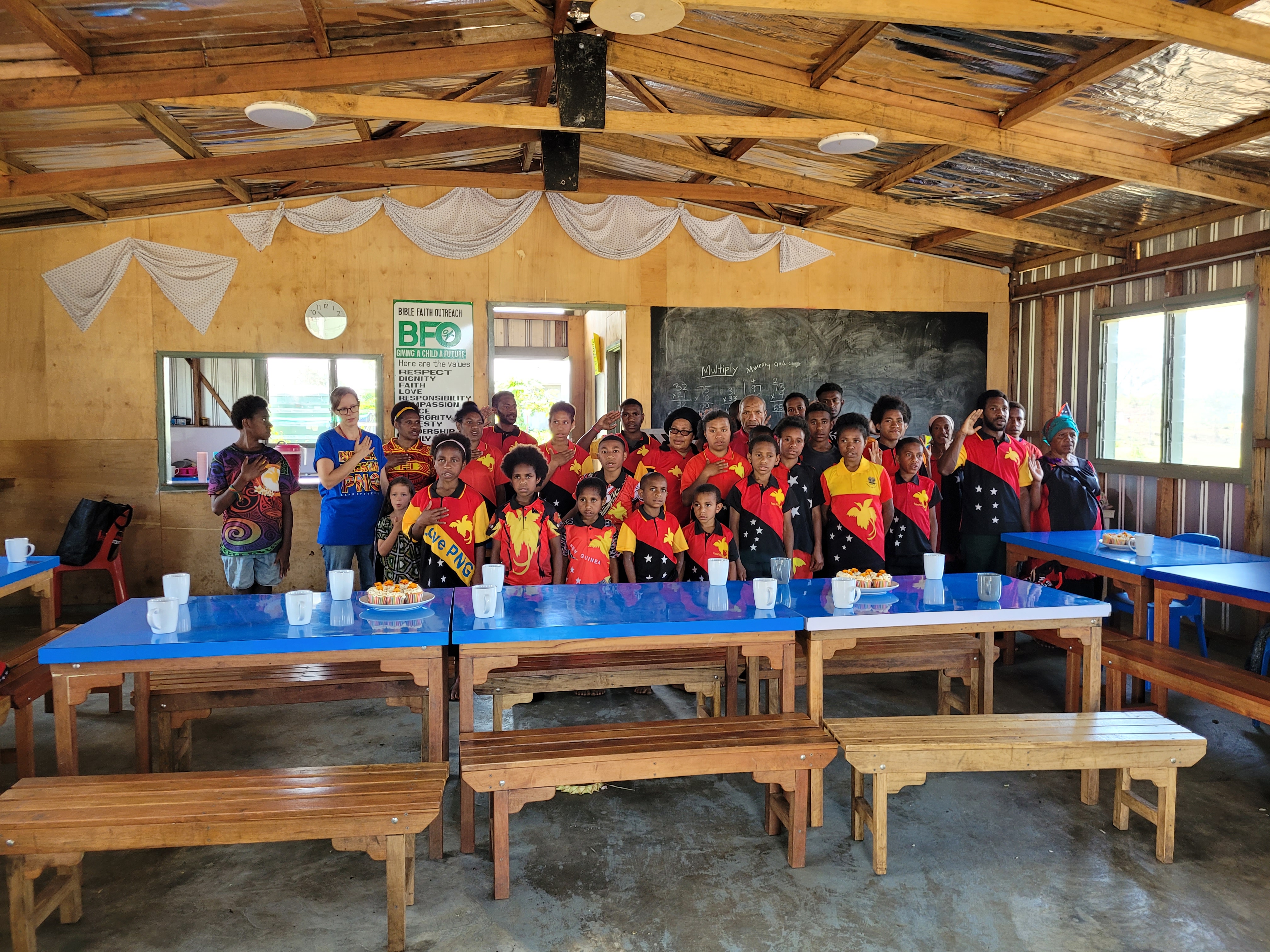
   My second visit to the orphanage was together with Brandon, Nova, and two other MAF families. The occasion for this visit was Independence Day! The children had planned some games, which were followed with the singing of the national anthem and a snack. After the snack, some of the older children still wanted to play more games (yes, the sun was scorching again!). While the younger ones stayed inside to colour and draw Papua New Guinea’s flag, Brandon and I took the older ones back outside to teach a new game. We decided on Capture the Flag, and everyone had a blast! It took the first few minutes to sort out all the rules (if you get caught, you must go to jail; you can’t free someone from jail and get the flag, etc.), but once it was all clear everyone had a lot of fun. I got tricked a few times when someone was walking casually on my side, pretending to be on my team – and then suddenly dashed for our flag. After playing several games, Brandon let them know that we would play one more. I heard someone comment behind me, “You mean 63 more?” I guess comments like that show how much they appreciated us playing with them! 
   This past Monday, I visited again -- this time as a teacher. Several of the high school students had been having trouble completing their homework, since they had no device or way to access the Internet. It seems that this is crucial to be able to complete Grade 12 especially. For some research assignments, these students simply had to say that they couldn't complete the homework and get a failing mark. In response to this, a laptop was purchased for their use. Though this seems like the solution to all of their problems, it is only the beginning; these students have never used a computer before, and are starting from scratch. 
   On the first day that they received the computer they were shown how to turn it on and off, how to log-in, how to access the Internet using Mommy's hotspot, and how to save a Word document onto a USB drive so it could be printed. The lesson that I gave was their second. Some of the first things that they learned with me were how to copy and paste, how to open multiple tabs on the Internet, and various features of Microsoft Word, like how to change the font, size, and colour of their text. 
   Our main focus was on learning the basics of typing, which I believe is becoming a more and more essential skill worldwide. After watching me type a few sentences, their eyes bulged -- when I explained that they could learn how to type like that too, they grinned and nodded enthusiastically. We learned how to make capital letters, and why there are bumps on the F and J keys. I also set each of these students up with an account on a website where they can learn to type for free. After about an hour of instruction, I left them to it with their laptop, my laptop, and a few paper "keyboards" to practice. When I came back to collect my laptop about 30 minutes later, they were competing against each other for the high score on a game that had them practicing the D, F, J, and K keys. Their desire to learn was infectious; I am excited to see how they have progressed when I visit next!

A view of the orphanage

The children singing their anthem, dressed very patriotically!

A New Year

     We wish you all a blessed new year and pray that God's grace will guide you in 2025. As we reflect on the past year, many different...