Monday, September 4, 2023

Patiently Waiting

As our time in Canada draws to what we originally thought would be a close, we are still patiently waiting for all of the paperwork needed to take Ezra with us to Papua New Guinea. Everything has gone slower than we originally expected, which means we have already delayed our flights by two weeks. We are hopeful that we won't have to change them again, which seems promising since we just heard that the immigration office gave a deadline for processing Ezra's visa about a week from now! We will continue to pray that everything comes through in time for us to leave Canada in three weeks. It is time to start ordering the last things we need, buying the last pieces of clothing for the kids, and start weighing everything to make sure it will fit in three suitcases! 


As we start to mentally prepare for a new beginning in PNG again, here is another section from one of our presentation which reflects on our first beginning in the country:

Our senses are overwhelmed with new sights, sounds, and smells when we arrive in PNG after more than 20 hours of flying. We notice all of the beautiful flowers that naturally grow in the tropical climate contrasted with the dusty, bumpy streets littered with trash. We feel many eyes as we walk down the streets, with many calling out "Morning! Good day! Baby! Baby!" We are extra cautious about protecting our belongings as we navigate our way through the crowds lining the streets, especially when ladies come up to squeeze our baby's cheeks or shake her hand or even try to pick her up. Going to the market is an exciting experience, though we still have a lot to learn. When we soak our vegetables in salt water, we are usually greeted with swarms of earwigs, worms, and other bugs who are desperately trying to escape the salt water. "Brandon! There's one there! On the wall! On the cupboard! Up by the ceiling!" Shopping is one long math game as we try to get quicker at mental calculations: "34 kina is how many dollars? Is this really expensive, or a normal price?" Driving requires our utmost attention as we get used to not only driving on the other side of the road, but also to the people who cross anytime and anywhere and the vehicles that drive a wide range of speeds -- and sometimes stop with no warning. 

In those first few days, our senses were in overdrive. Everything was new, everything was different, and we realized that we had a lot to learn.

Friday, July 28, 2023

Ezra

 We were blessed with a healthy baby boy last week! Ezra John was born on July 19th, and we have all been spending the past 10 days adjusting to life with a newborn in the house. Since he was born just over a week later than his due date, Ezra's arrival also meant we needed to start his paperwork process as soon as possible. We applied for his birth certificate the same day that he was born, and spent some time yesterday morning getting a passport photo taken. Eyes must be open, mouth closed -- that in itself is a difficult task. Next step: no hands on the picture (ours or his), and he needs to be held up in front of the white screen. And to top it all off, he should be (at least sort of) looking at the camera. Thankfully, we had a patient camera man and got a photo that they think will be approved! It's amazing how even a newborn can look like a criminal...

While we wait for a birth certificate, passport, and visa, we will continue to share brief updates together with a short excerpt of what we shared in our presentation.

I have been privileged to spend most of my flying time serving one of the most isolated and remote areas of Papua New Guinea. The Western Province is one of the largest and most inaccessible regions in PNG — with vast flatlands covered in river systems. Villages are dotted along the streams and rivers across the province, but the province lacks the infrastructure or transport options needed for its people to access healthcare or education. 


In lowland areas like the Western Province, it is exceptionally hot and humid. This, combined with a clay-like soil, makes it very difficult to grow many crops. Malnutrition is a common problem, as well as other health concerns including acute malaria. In some areas, water has been polluted due to improper treatment of mining wastes in the mountains to the north. If any area of the country needs healing, in all senses of the word, the Western Province is one of them. 


Healing processes have been started in this area through a partnership between MAF and another program known as the SDP, or Sustainable Development Program. Most of my flying has been and will be in this area, working with the program’s Aerial Health Patrol teams. 


Each Monday and Tuesday, we transport several health teams to a remote village in the province, where they stay for one or two weeks to provide much needed health services. During these patrols, the health workers see many patients (and sometimes call MAF for medical evacuations if they don’t have supplies or equipment to treat the patient), give lessons to the community on hygiene and personal practices that promote good health, and begin training a community health worker. 


Once their time in a particular village is complete, we will return to the nearest airstrip to transport them back to their base in Balimo, where they will prepare for their next patrol the next week. These dedicated health workers spend six weeks in the bush and then spend two weeks with their family before heading out for six more weeks of patrols. 


Without MAF flying 10 teams into approximately 40 airstrips in the Western Province, many people would not be reached. The teams would have to make long, dangerous trips by canoe and walking to reach each village — spending more time travelling than treating and teaching. Through our partnership, more people than ever are being reached and more villages are seeing a start to the healing that they have needed for so long. 


Saturday, July 15, 2023

A Cucumber and Two Carrots

     As promised in our last blog post, here is another story that we shared in one of our presentations:

    I exit the supermarket with my senses overloaded: One hand pushing a grocery cart, one hand holding Nova’s, one hand carrying my car keys, and one hand double checking to make sure none of my valuables are in sight. One eye looking to see who is around me, one eye checking for vehicles backing up or driving in, one eye making sure I am actually still holding Nova’s hand (and seeing that she’s getting her cheeks pinched yet again), and one eye noticing the faithful basket seller approaching me. One ear hearing, “Morning, whitie!” One ear hearing, “Nice baby!” and one ear hearing, “Come look! You like these baskets?” I tell the basket seller that his baskets are very nice, but that I can’t buy one today, then fasten Nova into her carseat before unloading my cart. 

    With the cart quickly unloaded and car doors shut, I have a decision to make: do I leave Nova in the car while I return my shopping cart, or do I take her out again? Thankfully, a guard approaches and offers to take my cart back for me. I jump into the driver seat and get ready to drive home. Just as I close my door, a young boy approaches my window, holding a stack of newspapers. I can’t hear what he is saying, so roll down my window just enough to say, “Sorry, I don’t need a newspaper today!” Before I can roll the window back up, he responds: “No... I’m hungry.”

    I look at the blazing noon-day sun, and ask, “Where’s your family?” *shrug* “Why are you not in school?” *shrug* “Have you eaten anything today?” *head shake* Looking into my back seat, I see my market bag from the stop I made at the market before getting groceries. I pull out a cucumber and two carrots and pass them through the window before leaving – less than a dollar for me, but his face lights up with a shy “Thank you.” Rolling my window up again, I leave the parking lot with a view in the mirror of the newspaper boy sitting on a curb eating his carrot. 

Friday, July 7, 2023

Back in Canada

   After travelling across the world once again, we have taken our time settling into a temporary routine in Canada. Our first weeks back were spent preparing for and sharing a few presentations as well as reacquainting with grandparents, parents, siblings, cousins, and aunts and uncles. Nova is thoroughly enjoying all of the attention she receives from family! 
   As we continue to anticipate the arrival of our little one and then take some time to adjust and get ready for our return to PNG, D.V, we expect the days and weeks remaining in Canada to fly by quickly. It has been great to have a chance to reconnect with family and friends, but at the same time we are excited for the steps lying ahead of us.
 
   Over the course of the next weeks, we plan to share some of the stories that we shared during our presentations (with only brief family updates). These are all stories that show different aspects of our life in PNG in the first 10 months that we were in country:

   While working in Balimo, situated in the Western Province of PNG, I am on my way back from picking up a medical team from Lake Murray when I get a medevac call. A patient in Kapal, a village, needs immediate medical care – and the only way for her to get this care is by being flown to a hospital. My plans change immediately. I drop the medical team off in Balimo, inform the next team that I cannot pick them up today anymore and prepare for the medevac. How much fuel do I need? How is the weather where I am going? Do I have enough daylight to return home? Does the patient require a stretcher, or can he or she sit in a seat? How will this affect the following days of flying? I call the Ops team to get more information, and then remove 2 seats from my plane and put a stretcher in their place and prepare for take-off. 
      Twenty minutes later I am on the ground in Kapal (a minimum 2-day trip by boat and land from Balimo). Kapal is a bush village with no health workers, clinic, or school - it is only serviced by the AHP health teams.
   I learn that a young mother had a miscarriage, and the bleeding is not stopping.  Her family helps carry her to the airplane and I secure her in the aircraft on our stretcher. She is weak and I can see the pain in her eyes. Since there is not medical worker, I ask for a family member to accompany and watch her as we fly. Flying can cause medical conditions to deteriorate, so it is important to always have someone accompanying a medical patient. After praying for her and a briefing for the flight we take off towards Daru, a 20 minute flight, where there is a hospital. On route I call for them to have an ambulance ready -- which is just a truck -- so she can get to the hospital as quickly as possible.

    When I do these kind of flights the realities of bush living and lack of proper medical care hit me again and again. I can often see the pain in the eyes of health workers as they battle through the overwhelming need of the isolated each day and I feel privileged to be able to serve with them, realizing that we do not control life but are still called serve to bring help to best of our abilities.


Friday, May 5, 2023

Preparing for Change

 With what feels like only a snap of our fingers, our family is again preparing to enter a time of transition and change. After a little less than a year in Mount Hagen, we are now getting ready -- both physically and mentally -- to leave the "settled" feeling of daily routines and comfort for many exciting changes!

We had the chance to explore Balimo recently, which is where we hope to make our new home when we return to PNG. In our six days there, it was great to get a feel for daily life in the hot and sticky... Or should I say the VERY hot and VERY sticky? Walking around town in the remote lowlands offered a completely different experience of Papua New Guinea than our current life; people are generally shy, quiet, and friendly, whereas the city is noisy with constant cat-calling and strangers are not afraid to test our confidence and knowledge of how things work at nearly every turn. We discovered what the Balimo market had to offer, getting the chance to try a new fruit (lychee) and learn how to cook a turtle, though we decided we weren't quite ready to take the step of buying the live turtle!

Brandon's time in Balimo was filled with flying. When he wasn't dropping off a health team or picking one up, he was performing other critical flights including two medevacs. "Work" and "ministry" took on a whole new meaning in the context of serving the people that live in the same area as we are living in. It offers the joy of being more connected to individuals by getting to know passengers by name and to hear their stories -- but it also means sharing in the grief and difficulties that are almost synonymous with remote village life. This time really reinforced our calling to serve in Balimo, which is situated in the most isolated and needy province of Papua New Guinea.


There are still a few steps for us to take before we make the move to Balimo, however. Our house in Mount Hagen is looking emptier and more bare with each day that passes. "Pictures? Clean up? Books? In Suitcase?" is Nova's way of processing the changes in her life, but she has yet to fully comprehend that we are scheduled to be on an airplane headed back to Canada in less than a week! We are all looking forward to seeing our family again (and meeting the new addition to our family soon, D.V.), but there are definitely mixed feelings circulating about what we know will be a whirlwind of a summer. It seems that regardless of how much we practice, transition and change are always unsettling. 

Trying to embrace this feeling as much as possible, I am reminded of Moses, who I think often had similar feelings of chaos in the middle of change and uncertainty. In one of his conversations with the Lord, he begs God to show him the way that he should go so he can be certain he is following God's will regardless of chaotic and confused thoughts and feelings. The Lord's response to Moses in this time is something that offers peace for us now as well: "And he said, My presence shall go with thee, and I will give thee rest." 

Wednesday, April 19, 2023

Bush Orientation Part 3: Services in Sangapi

 Nearing the end of our time in Sangapi, we plan to use our last two days to continue to learn and experience as much as possible! Each Monday, individuals from the surrounding communities are able to receive free medicine from the health clinic. The catch is that they must spend the morning working to make sure that the area stays neat and tidy -- and only after lunch can they receive the medicine. 

While everyone is busy working in the morning, we ask the health workers for a tour of their facilities. They show us some of the medicine and tools that they have, but also explain that their ability to provide care for more complex illnesses or injuries is limited. After the tour, I (Nellicia) am interested in seeing the health clinic in action, so I return after lunch while Brandon stays with a napping Nova. A large group of people is waiting in the grass, listening to one of the health workers. He is giving them a stern lecture about how medicine isn't the only solution -- prevention is a better method. "You can spend 10 kina on a bag of rice, so I know that you can spend 2 kina on a bar of soap. Use the soap! Wash! Clean yourself! If you are always dirty you will be sick. Do you sleep with your pigs or dogs? Is your toilet house on the hill above your cooking house? These things are dirty, and you will get sick. You must learn these things first to prevent sickness. Until you learn them, you will always be sick and always need medicine." 

After listening to the 'lesson' for awhile, I head to the porch where people are being called to share what is wrong and to receive their medicine. Many of the sick are tested for malaria -- even though Sangapi is not a malaria zone because of the high elevation, most people frequently travel down to the rivers and valleys, and can be infected there. Some come to receive treatment for tuberculosis, a disease which no longer exists in Canada but continues to be one of the most serious health concerns in PNG. A few people report aches, pains, or strains and are prescribed enough Acetaminophen to last for a week; others come with pregnancy complications that the health workers can do nothing about, other than to encourage them to find some money so they can go to a larger hospital. For some, such as an elderly man with bone cancer, there is no treatment available in the country, so he is simply told to return to his village. 


The difference that the health clinic is making for many people is phenomenal, but still I am left with a twisted feeling in my gut. There are so many people who can't receive the healthcare that they need because it doesn't exist within the country, or because they don't have money, or because they are afraid to go to a clinic because of a stigma or curse, or for a host of other reasons. At the end of the day, the people accept it. It is the only way they know. Most mothers have lost at least half of their children. Cripples are a common sight, and gaping, infected wounds with flies eating the flesh go untreated, usually starting as a small scrape. These are heartbreaking realities, but in the midst of them I must continue to remind myself to see the successes of those trying to help these people; the lives that are saved.  

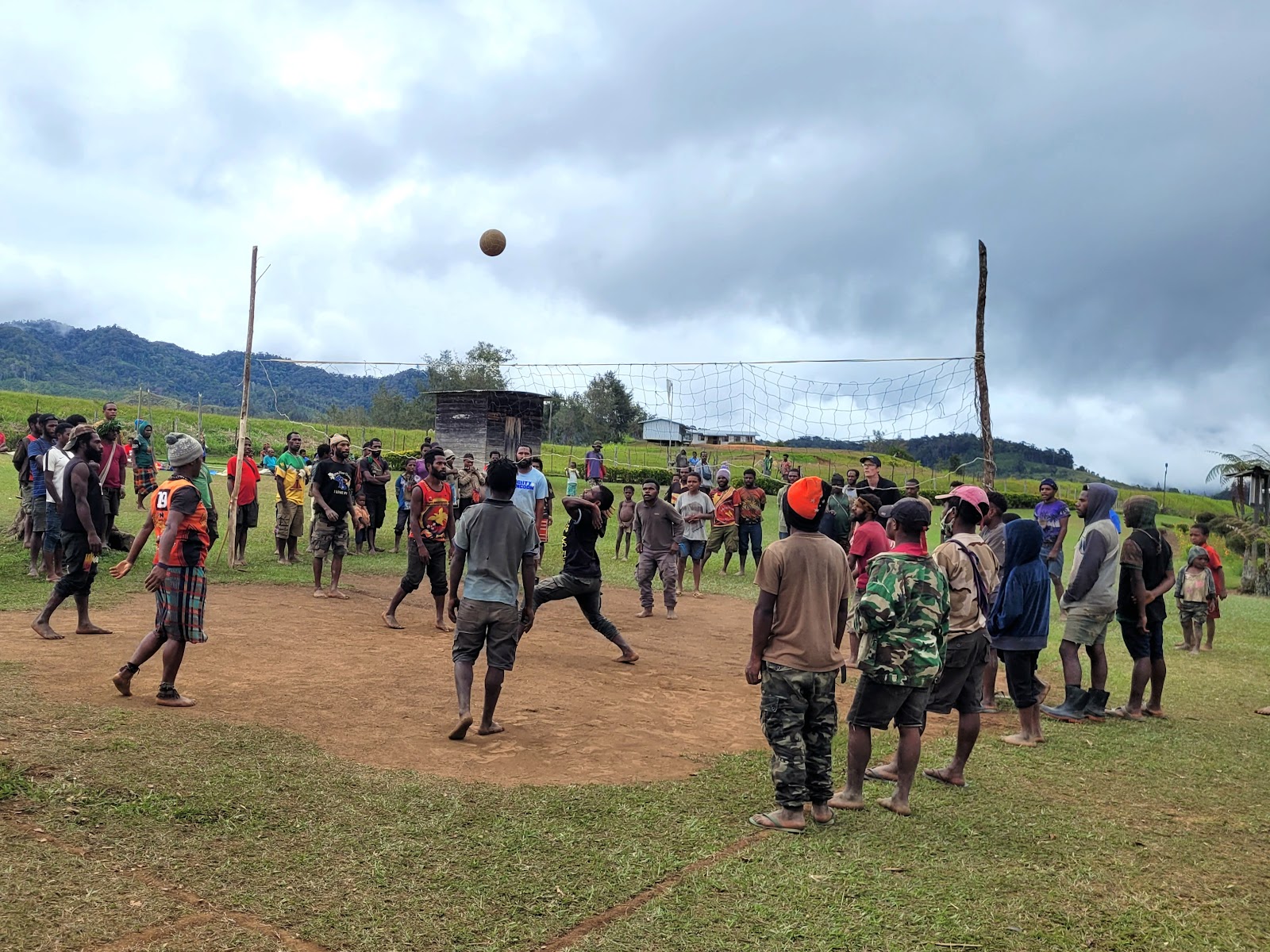
Later in the afternoon, as the rain is putting an end to the "traditional" afternoon volleyball game, a group of people arrive with a teenage boy on a stretcher. Dusk is approaching, but the health workers greet the arrivals and get to work. Since this was our day of medical learning anyways, we decide to go to the clinic to see what is happening. Talking to the boy's father, we learn that his son fell from a tree while hunting a tree kangaroo and broke his leg. They created a stretcher out of bush materials and carried him to Sangapi, because it was the nearest clinic. When we ask how long it took to get here, we are reminded of the reality of living in the bush once again: "We left on Friday morning and walked all day every day to get here." It is Monday evening. After the boy is transferred from the stretcher to a bed and given some medication to control his pain, we talk to the health workers. They inform us that the boy broke his femur and will need a surgery that they cannot provide; the only thing they are able to do is control his pain. He will need a medivac flight to get to a proper hospital -- the health worker will try to call MAF in the morning. 

Tuesday morning, we ask how the boy is doing and if a flight will be coming to pick him up. The health worker replies that he is not sure, because the family didn't bring money to pay for hospital fees -- they must first return to their village to find some money. Leaving the injured teenager at the clinic, they depart in the morning on the 3-day journey back to their village. Yet again, my heart aches at the reality of this situation and how common I know it to be. 

We spend the rest of the morning at the local primary school, since we heard that a teacher (finally) arrived! I was really hoping to see the school in action, and assumed this would be possible since the school term officially started the week before we arrived. However, as all things take time in PNG, it also takes time for teachers to arrive at school and begin teaching. We meet the teacher and learn that this week will be enrolment week; he is hoping that the rest of the teachers will arrive by the next week. The teacher shows us the curriculum he uses and gives a tour of the classrooms. For this area, tuition for the school year is 20 kina (about $8 CAD), but even still some cannot afford it. 


As a teacher myself, I am interested in what it is like to be a teacher in PNG. I ask a few questions about his schooling, philosophy, and job, and learn a some interesting facts: 1. In PNG, you acquire a teaching licence at a college, not a university, which is seen as a lesser level of education than a business degree, for example. 2. This particular teacher has been teaching for 3 years, but has not received any payment for his work yet. The government is supposed to "backpay" any amounts not given on time, but he does not know when he will begin to receive pay. 3. Since there are so many different local languages, education is standardized into English. Students must speak English at all times, and are punished if they speak their own language. Often, teachers are not fluent in English themselves. 


Thanking the teacher for his insights, we head back to our house for lunch and nap time. Since our plane is supposed to arrive first thing tomorrow morning, we also get a head start on packing up and relax for our last evening in Sangapi. 

On our final morning in Sangapi, we eat breakfast, do a quick clean of the house, and move our things outside. The skies tell us that it is not a guarantee that the plane will be able to make it, but we want to be prepared! We head out to find someone who has contact with MAF to ask what time the plane is planning to arrive. Over the course of the morning, clouds come and go, rain comes and goes, and our expectations go up and down. "The plane will be here in 15 minutes! It just left and is on it's way!" Half an hour later, we discover it still hasn't left because of bad weather. After several hours of "Yes, it's coming!" "No... the weather is not very good." "The plane hasn't been able to leave yet..." "It should be here in half an hour!" and not seeing a plane, we decide that the plane most likely won't be able to come today after all. 


At about 2:00, after keeping Nova awake all morning from her nap so that she could sleep on the plane, we let Nova get the sleep she so desperately needs by this point in the day, and create a mental plan of what we will have for our unexpected extra dinner in Sangapi. Just as Nova starts snoring, someone comes running and says, "The plane is almost here! We need to move your things to the airstrip now!" After confirming that it really is the truth this time, we go into turbo-mode: (sorry about the 15 minute nap, Nova), carry all of the things to the airstrip, and walk up to the airstrip just as the plane is landing. Soon after, we are sitting in the plane with the clouds rolling in once again. As the pilot turns the plane on, the rain starts pouring, and we take off just in time to make it through a hole in the clouds and back to Mount Hagen. This was a real experience of what it means to depend on a MAF airplane (and consequently, the weather)! 


Monday, March 20, 2023

Bush Orientation Part 2: Culture Conversations

 On Day 3 of our time in Sangapi, we start off the morning with a hike up to another ridge nearby. This time, we are accompanied by the village health workers, who are hosting us. They offer a lot of insight into cultural practices, which makes our time with them very educational! Like all of the trails up and down the mountainsides, the shortest route is taken: straight up the slope. Having received some rain the previous night, the red clay quickly turns to mud and is exceptionally slick. Keeping one foot in the grass on the side of the trail is my approach to gaining some traction; since our hiking s
hoes were still drying after washing them following yesterday's trek, our Crocs and flip-flops are not the most ideal footwear! 

After an approximately 45-minute hike, we arrive at the top of the ridge and walk a little further down the trail to meet some of the people who live on this ridge top. The owner of a piece of land shows us his two houses, as well as the new house that is currently being constructed. One of the houses is built on stilts, which prompts a discussion about why houses are built differently. We learn that it comes down to preference: often, younger people enjoy houses on stilts, whereas the older generation usually prefer to sleep on the ground level where the floor retains heat better during cool nights. After taking some time to look around and ask questions, we make the trek back to Sangapi where Nova is able to play for awhile before nap time. With another volleyball game and dinner also complete soon after, we are ready to relax for the evening. 

We heard the news that Saturdays are a community meeting day in Sangapi, so we are excited to see what the day will bring when we wake up! Everything is still very quiet when we head outside around 9am, so we start with a walk up the airstrip. There are many gardens on all of the slopes leading down the ridge; this morning, however, we see people actively at work in a garden that is close by. Asking a few kids who are tagging along with us if they know how to get to that garden, they lead the way and we ask for a tour when we arrive. The owners of the land are thrilled to show us around their "yard," explaining how life is for them. One gentleman wants us to ask as many questions as possible, and he shares his worldview with us very openly. His pride of Sangapi, his tribe, and the peace that they exhibit shines through in all of his answers. Following a conversation with him, his elderly father arrives from working in his new garden. Like son, the father is eager to show us the work he was doing and demonstrates how he uses a shovel to manually turn all of the soil before planting. Mid-work, he turns his toque so that it is straight (yes, we're still trying to understand how so many people wear toques in the scorching heat!), poses, and explains that this would be a very good picture. 

After a tour of the garden, the son shows us his wives' houses as well as his own. Traditionally, husbands are never allowed to enter their wife's house, and vice versa. Since this seemed to be a very traditional family, we asked some direct questions -- and got some answers that were more direct than others. "You have two wives? How many do you want?" "You are never allowed in each others' house? How is it possible for you to have children?" "Do your wives ever fight with each other?" Though they thought it was pretty funny for us to be asking these questions out loud, they were surprisingly open with us. We learned that this particular man wanted 5 wives (which would take awhile, considering the bride prices in the area), that the garden is used for having children, and that he is very fair and takes turns with his wives so they don't fight. While amusing to us, this is just life for many people in PNG; the way it has been is often the way it will be. 

We thank the family for their tour and then head back to the village to see if the community event has started. People come to this event each weekend, some hiking 2-3 hours to arrive. This means that people trickle in slowly, but by noon the air is lively with chatter, a small market, and volleyball and basketball tournaments. Brandon joins the Sangapi team in a volleyball tournament: when it is his turn to play, the crowds flock around to watch the "tall white man." If he doesn't hit the ball for a minute or two, they all start calling out, "White man! White man!" If he hits the ball (or even better, spikes it), the crowd goes into an uproar of cheering and laughter. By uproar, I mean that Nellicia could hear exactly when Brandon hit the ball from our house, which was a 5-10 minute walk away! We had a great afternoon talking to people from various communities, and really enjoyed the event -- it was so simple, but allowed so many people to connect with each other in friendly conversations and sport. 


With yet another busy day complete, we relaxed for the evening and prepared for Sunday. In church on Sunday, while most people sit on low benches that are about 6 inches off of the dirt floor, we were treated as guests of honour with plastic chairs. After speaking only Tok Pisin since our arrival, we were able to follow the sermon quite easily, which was a sign of our progress! We were all thankful for a day of rest after the busy days we had just had, and at the end of the day were excited for the new week ahead. 

A New Year

     We wish you all a blessed new year and pray that God's grace will guide you in 2025. As we reflect on the past year, many different...